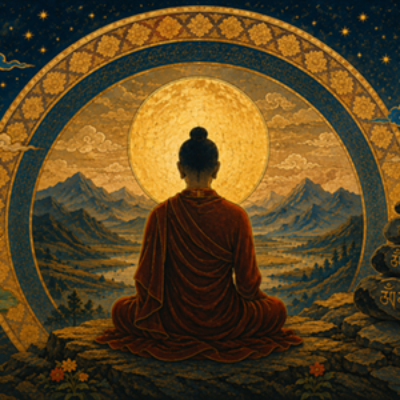
How much of our stress comes from needing to know? We want to know what will happen next, whether we are making the right decision, how other people feel about us, and whether our plans will succeed. Much of our anxiety arises not from uncertainty itself, but from our discomfort with uncertainty. We search for solid ground in a world that is constantly changing. The Dharma invites us to discover a different relationship with not knowing, not as a problem to solve, but as a doorway to wisdom.
Modern life often tells us that knowledge is the answer to everything. If we gather enough information, make enough plans, and think hard enough, we imagine we can secure ourselves against uncertainty. Yet life continually reminds us otherwise. Relationships change. Circumstances change. Our health changes. Even our understanding changes. The more tightly we cling to certainty, the more fragile and anxious we often become.
The Illusion of Certainty
The Buddha taught that all conditioned things are impermanent and constantly changing. Yet much of our suffering comes from acting as though people, circumstances, and even our own lives should remain stable. We seek certainty in a world whose very nature is change. Perhaps the deeper question is not how to eliminate uncertainty, but how to live wisely within it.
Contemporary Buddhist teacher Pema Chodron writes in Comfortable with Uncertainty that much of life is fundamentally groundless. Rather than seeing this as a problem, Buddhism invites us to discover freedom within this openness. The spiritual path does not promise certainty. It offers something more valuable: the ability to meet uncertainty with awareness, courage, and compassion.
Don’t Know Mind
Korean Zen Master Seung Sahn often spoke of “Don’t Know Mind.” He was not encouraging ignorance. Rather, he was pointing toward a mind that remains open, curious, and free from fixed ideas. Japanese Zen Master Shunryu Suzuki taught a similar principle called shoshin, or Beginner’s Mind. Though expressed differently, both point toward the same insight. Wisdom does not come from clinging to what we think we know. It comes from meeting each moment with openness, curiosity, and humility.
We often enter conversations believing we already know what another person means. We enter situations believing we already know what will happen. We approach ourselves believing we already know who we are. Over time, we can even stop seeing our jobs, relationships, communities, and spiritual practice clearly because they become familiar. We assume we know what is there, and in doing so we stop paying attention.
Beginner’s Mind does not mean becoming naive. It means remaining open to learning, even from situations we think we already understand. In everyday speech, “I don’t know” often sounds like confusion. In the Dharma, it can also be an expression of humility, openness, and freedom from fixed views.
This is the art of not knowing. Instead of rushing to conclusions, we pause. Instead of immediately labeling an experience, we become curious. Instead of insisting that we already understand, we make room for discovery. Not knowing is not a lack of wisdom. It is the willingness to remain open to wisdom.
When we approach life with “Don’t Know Mind,” ordinary experiences can become alive again. We begin to see possibilities, insights, and connections that certainty often hides from view.
The Inconceivable
In the Vimalakirti Sutra, the lay bodhisattva Vimalakirti, a spiritual ancestor in the BFF lineage, is renowned for revealing profound truths through ordinary life. In the famous chapter on nonduality, many bodhisattvas offer explanations of ultimate reality. Then Manjushri asks Vimalakirti for his understanding. Vimalakirti responds with silence.
This “thunderous silence” points toward what Buddhist traditions call the inconceivable. It is not something irrational or supernatural. Rather, it is reality in its fullness, always greater than our attempts to describe it.
Most of us have encountered moments like this. Standing before the ocean. Watching a sunrise. Holding a newborn child. Sitting beside someone who is dying. In such moments words often fall away. We understand something deeply, yet cannot fully explain it.
My Shin Buddhist teacher, Taitetsu Unno, expressed a similar insight when he described Suchness, reality as it truly is before we divide it into concepts and labels, as inconceivable and beyond conceptual grasp. Yet he also emphasized a profound paradox: what is beyond words nevertheless expresses itself through words, teachings, compassion, and everyday life. In his book Bits of Rubble Turn Into Gold, he shares a poem that beautifully expresses this relationship between silence and expression:
The nembutsu comes from the world of silence,
Yet I hear my voice
Saying Namu Amida Butsu.
Whether understood through Zen, Pure Land, or another path, the point is the same. The inconceivable is not something distant or abstract. It is the living reality that exceeds every concept, yet continuously reveals itself through each moment of our lives. Words may point toward it, but they can never contain it.
From Certainty to Wonder
The deepest questions of life may never be solved intellectually. Buddhism does not always provide final answers. Instead, it invites us to live the questions.
We do not need to understand everything in order to live wisely. We do not need to solve every mystery before we can love, serve, practice, or trust. The art of not knowing is learning to live comfortably with questions that cannot be answered immediately. When we stop demanding certainty, we make room for humility, wonder, gratitude, and awe. Not knowing becomes less a source of fear and more a source of openness.
Perhaps the goal of the spiritual path is not to eliminate mystery, but to learn how to live gracefully within it.
Home Practice
Practice 1: Beginner’s Mind
Once each day, choose a familiar activity and experience it as if for the first time.
Ask: “What am I noticing that I usually overlook?”
Practice 2: Resting in Not Knowing
When uncertainty arises:
- Pause.
- Take three conscious breaths.
- Let go of the need for an immediate answer.
- Rest in not knowing for one minute.
Ask: “What does this openness feel like?”
Written by Rev. G.R. Lewis, M.A. © G.R. Lewis,
Buddhist Faith Fellowship, June 2026