The Human Question
Every human life is shaped by change. We are born, we grow, we love, we struggle, and we eventually face death. Along the way, questions naturally arise:
What is this life?
Why do we suffer?
What happens when we die?
Is there something more than this constant movement of change?
Buddhism does not turn away from these questions. It invites us to look deeply, not to arrive at fixed beliefs, but to awaken to a deeper understanding of Reality itself.
Karma and Intention
Karma is often misunderstood as fate, reward, or punishment. The Buddha taught something far more subtle.
Karma simply means intentional action. It refers to actions of body, speech, and mind, sometimes called the Three Gates of Karma. Every intention, every word, and every action leaves an imprint that shapes our experience and influences the world around us.
Karma is not something imposed from outside. It is the natural unfolding of cause and effect within the fabric of Reality. No one rewards or punishes us. Karma is participation.
This does not mean that everything that happens is deserved or predetermined. Our lives are shaped by countless causes and conditions, many beyond our control. Yet within this complexity, intention matters. Each moment offers the possibility of planting new seeds through awareness, compassion, and wisdom.
From a deeper perspective, karma is not only about what we do, but how we perceive. Our habits of thought and feeling shape the way Reality appears to us. As awareness deepens, these patterns become more visible and less binding.
Rebirth and Reincarnation
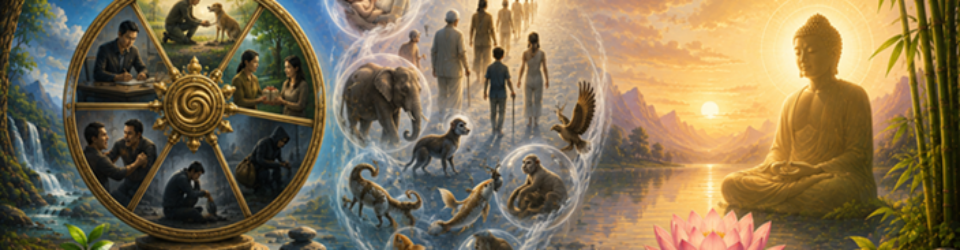
Buddhism clearly teaches rebirth, not reincarnation, and this distinction is essential.
Reincarnation usually refers to the idea that a fixed, unchanging soul or self moves from one body to another. Buddhism does not teach this. The Buddha rejected the idea of a permanent, independent self that continues unchanged through time.
Rebirth points to something more subtle. It describes continuity without a fixed identity. What continues is not a soul, but a dynamic stream of experience shaped by karma, a flow of tendencies, intentions, and patterns.
This is not something permanent moving from one place to another. It is an ongoing process of becoming. Each moment conditions the next. In this sense, we are being “reborn” moment by moment even within this life.
Nothing solid carries over, yet nothing is disconnected. Life continues through cause and condition, not through a fixed self. This is why Buddhism can speak of continuity without asserting a permanent identity.
Nirvana, Awakening, and Liberation
Nirvana is one of the most misunderstood teachings in Buddhism. It is often mistaken for a heaven, a paradise, or a place one goes after death. The Buddha did not teach Nirvana in this way.
Nirvana is not a place. It is not an escape from life, and not the end of experience. It is a state of awakening, more precisely, the fulfillment of awakening.
Nirvana is the peace that naturally arises when Reality is seen as it truly is.
The word Nirvana literally means “to extinguish,” like a flame or campfire going out when its fuel is exhausted. This image does not mean that something real is destroyed. Rather, it points to the extinguishing of the fires that keep suffering alive, greed, aversion, and ignorance.
As long as these fires are fed, the cycle of samsara continues, the ongoing pattern of birth, aging, illness, and death shaped by craving and clinging. When these fires are no longer sustained, they naturally settle. This is the cessation of suffering. It is the ending of ignorance, craving, and grasping that bind us to samsara.
For this reason, Nirvana is sometimes called the deathless. Not because the body does not die, but because what is realized is no longer bound in the same way to the cycle of birth and death. It is not a continuation within samsara, but a freedom from its binding force.
Nirvana is not something we create. It is something we uncover.
From a deeper Mahayana perspective, Nirvana is not separate from samsara and not separate from the nature of Reality itself. This does not mean they are the same at the level of experience. Rather, it means that when Reality is clearly seen, the distinction between bondage and freedom is transformed. Samsara is experienced differently because it is no longer grasped in the same way.
In this sense, Nirvana is not annihilation, and not escape into another realm. It is the direct realization of Reality, empty, luminous, and unobstructed. It is the full maturation of awakening, where wisdom and freedom are no longer partial or fleeting.
This is why Nirvana is not the end, but the fulfillment. It is the completion of the path, the realization of what has always been present, and the end of wandering within confusion.
Liberation in Buddhism is therefore not about going somewhere else. It is about seeing clearly, letting go, and awakening to the nature of Reality itself. As this awakening deepens, the patterns that once bound us lose their force, and life is lived with greater clarity, compassion, and freedom.
© 2026 G.R. Lewis. All rights reserved.
Permission is granted to share this material for noncommercial educational, personal, or Buddhist community use, with credit to G.R. Lewis and the Buddhist Faith Fellowship.