YOU BELONG HERE.
At the Buddhist Faith Fellowship, we believe Buddhism is not about retreating from life, but awakening within it. You do not need to become someone else to walk this path. You do not need to adopt a new identity or leave your life behind.
You don’t need to shave your head, wear robes, or withdraw from the world to practice the Buddha’s teachings.
We are everyday people—parents, teachers, artists, and seekers—learning to meet life with greater clarity, compassion, and presence, guided by the timeless wisdom of the Buddha.
Join us in discovering a path of clarity, compassion, and awakening, not apart from life, but in the very midst of it.
Be still; truth arises in silence.
The Buddhist Faith Fellowship in Middletown, Connecticut is a contemplative center rooted in stillness, inquiry, and compassionate presence. Here, we create space to pause, listen deeply, and rediscover the clarity already within us. Through meditation, reflection, and shared practice, mindfulness deepens, wisdom unfolds, and compassion naturally expresses itself in our lives.
We offer a range of gatherings and programsin, cluding Meditation & Talk Sundays, mindfulness retreats, Buddhism courses, and spiritual and outdoor activities, and field trips, designed to make the teachings accessible and meaningful in everyday life. See our Courses and Programs tabs or calendar for current activities. We are open to the public; no experience or knowledge of Buddhism is necessary.
As a community of individuals from a variety of religious and non-religious backgrounds, we are deeply inspired by the wise and compassionate example of the historical Buddha and the living Buddhist teachings clarified by generations of great teachers. What moves us most is the call of boundless compassion that welcomes us just as we are. Through the traditional Three Trainings of ethics, mindfulness, and wisdom, alongside teachings such as Other Power (grace), trust, and gratitude, we offer a practical and accessible path to greater peace and fulfillment in this moment and beyond.
Our mission and vision focus on sharing, promoting, and practicing the Buddhist teachings without any political agenda. We do not endorse any political theory, ideology, or social activism, but we solely focus and rely on the Three Jewels—Buddha, Dharma, and Sangha. We believe that the Buddhadharma itself, the Buddhist Teachings, is enough to transform the world one person at a time, starting with each of us.
We recognize that lasting transformation begins from within. To bring more clarity, compassion, and meaningful connection into our lives, we work with the habits and patterns that shape our experience, transforming distraction and self-centeredness into greater awareness, care, and responsiveness to others. In this way, understanding deepens, and compassion becomes something we naturally live and express.
Our practice emphasizes mindfulness, inner inquiry, and wholehearted engagement with life, helping each of us grow toward embodying wisdom and compassion in the world.
At the same time, we recognize how easily modern life can draw us outward. We are often encouraged to seek happiness, security, and relief through constant activity, consumption, or distraction. While these may offer temporary comfort, they can also pull us away from a deeper source of well-being.
At the Buddhist Faith Fellowship, we do not reject the modern world, nor do we judge those seeking relief in different ways. Rather, we gently question the assumption that lasting fulfillment can be found outside ourselves. Instead, we invite a return to an inner refuge—grounded in awareness, ethical living, wisdom, and compassion, as the true foundation for healing, happiness, and freedom.
We warmly invite everyone to participate in our gatherings, courses, and retreats—no prior knowledge or experience with Buddhism is needed. Our approach to the Buddhist teachings and practices is designed to be highly accessible and supportive, offering practical insights that are easy to follow and meaningful for people from all walks of life. As our dharma teacher often says, “Come and join us, just as you are.”
Our Story
Our journey began on Hana-matsuri Festival in April 2001, celebrating the historical Buddha’s birth, when a small group gathered in Rev. G.R. Lewis’ apartment in Bristol, Connecticut, near ESPN.
Inspired by his studies under Venerable Thich Tri Hoang—a 43rd-generation member of the Lieu Quan lineage in the Thièn Lâm Te (Linji Chan, i.e., Rinzai Zen) school—and after receiving lamp transmission and ordination as a dharma teacher in the Dharma Teacher Order in 2000, our founding teacher, Rev. G.R. Lewis, M.A. (Wisdom Vow), studies and training drew on Theravada, Mahayana, Thièn (Vietnamese Zen), and Pure Land traditions.
Seeking to deepen his education, he then continued his studies under prominent teachers in the Shin Buddhist and Vajrayana schools, including the late Rev. Taitetsu Unno, Ph.D., through his Lay Teacher’s Program at the Northampton Shin Sangha in Massachusetts. Galvanized by Rev. Unno vision, Rev. Lewis formally established the Buddhist Faith Fellowship in 2001 as Connecticut’s first independent group blending Zen and Shin traditions, with the aim to invite a new generation into the path of awakening and compassion.. Over decades, he has refined this vision and teachings, forging a new path from self-effort to grace that truly reflects Mahayana’s non-duality—advaya.
The first years of the Buddhist Faith Fellowship were filled with shared purpose, but soon outgrew the little apartment. After searching for a public place to gather, we found a low-budget space at Elmwood Community Center in West Hartford where we meet for two years. In 2004, we found a spiritual home at Wesleyan University in Middletown, first meeting at Memorial Chapel before moving to the Mansfield Freeman Center for East Asian Studies, which includes a tatami room and overlooks the beautiful Shôyôan Teien Zen garden, which has inspired our Meditation & Talk Sundays.
Since then, over the years, our fellowship grew into a vibrant Buddhist community, offering a variety of enriching programs, courses, workshops, and retreats. We expanded to include local chapters across the United States, providing resources and support to a diverse range of practitioners. While some initiatives, such as our environmental, philosophical, and family groups, were phased out, their legacy of community and spiritual growth continued to inspire our mission.
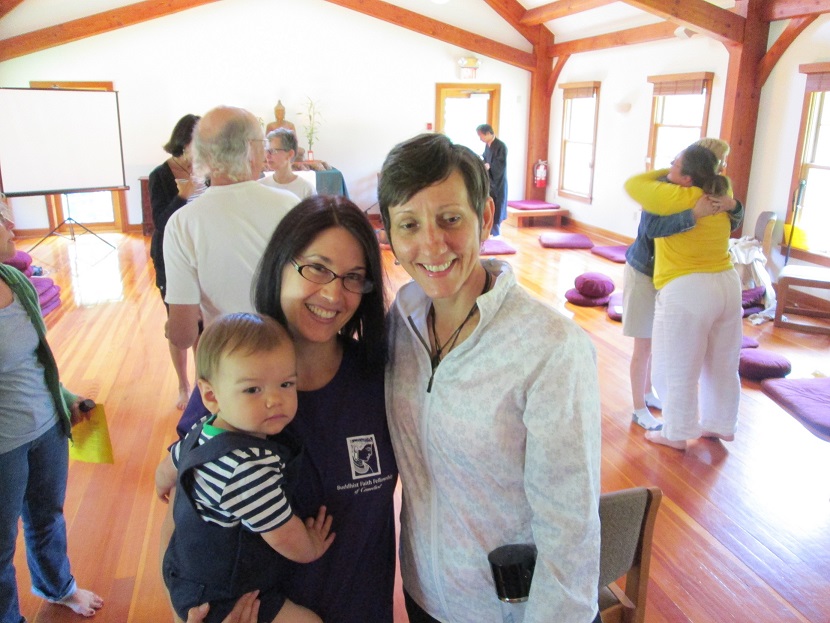
For sixteen years, our fellowship’s activities were held exclusively in Middletown, Connecticut. In 2020, during the global health crisis, we transitioned to an online format. What began as a necessary shift soon became an unexpected opportunity, expanding our reach to participants across the country and around the world through our Meditation & Talk gatherings.
Following the pandemic, we joyfully resumed our in-person activities in Middletown while continuing to grow our online presence. We have also expanded our outreach through platforms such as Meetup, Facebook, X, and Instagram, and have renewed our commitment to outdoor and field trip activities, inviting all to take part in this evolving and transformative journey.
As of this writing, the Buddhist Faith Fellowship is one of the few communities in New England—serving Connecticut, Rhode Island, Massachusetts, Vermont, New Hampshire, and Maine—offering an integrative path that brings together Zen, Pure Land (including Shin), and selected Vajrayana teachings in a unique and accessible w
Our story is still unfolding. We invite you to be part of it. Join us on Sunday mornings, or in our courses and retreats, and experience a path of mindfulness, grace, and connection.
Our Approach to the Teachings
From the ultimate perspective, our path does not teach anything in the conventional sense. As D. T. Suzuki wrote, “Zen (as meditation) teaches nothing; it merely enables us to wake up and become aware. It does not teach, it points.”
In our tradition, awakening is not understood as belief in a creator God or fixed doctrines, but as a direct realization of Reality itself—one that expresses as boundless wisdom and compassion, beyond all heavens, beyond all gods, beyond all separation.
Buddhist practice gently awakens us from our personal narratives and the cultural habits that shape our sense of self and world. It invites us to recognize a clear, natural living awareness already present within us, what Mahayana traditions call Buddha Nature, and what we experience as a lived sense of grace and compassion in ordinary life.
Our teachings grow from the great stream of Mahayana Buddhism, the Universal Vehicle, with a special emphasis on Zen and Pure Land. Like the 17th century Zen Master Bankei, who spoke of the simple, ever present “Unborn Mind,” and the 13th century teacher Shinran Shonin, who taught the way of deep trust and gratitude through the Great Compassion known as Amida Buddha, we seek to make the Buddhadharma accessible for everyday people in the midst of ordinary life. What may seem like complex teachings are, at heart, reminders that awakening and compassion are available to all of us, here and now.
The Buddhist Faith Fellowship draws from the richness of the Mahayana tradition, particularly the Zen, Pure Land (including Shin), and Tathagatagarbha traditions, while also incorporating selected contemplative teachings and practices from Vajrayana Buddhism. We honor the Buddha’s Three Turnings of the Wheel of Dharma: the First Turning, which establishes the path through the Four Noble Truths and Noble Eightfold Path; the Second Turning, which deepens our understanding through the wisdom of emptiness, compassion, and the Bodhisattva path; and the Third Turning, which reveals the teachings of Buddha Nature and the innate potential for awakening present in every being.
To help illuminate these teachings, we draw upon the insights of the 6th-century Master Zhiyi (Chi-i) and his teaching of the Three Truths: Provisional Truth (samvriti satya), the world of everyday appearances and distinctions; Ultimate Truth (paramartha satya), the reality of emptiness beyond conceptual limits; and the Middle Way (madhyama pratipad), the nondual realization that the provisional and ultimate are inseparable. Simply put, this framework helps us see that ordinary appearances and ultimate reality are not separate but mutually interpenetrating. This insight resonates with the Heart Sutra, which reminds us that “form is emptiness, emptiness is form; form does not differ from emptiness, emptiness does not differ from form.” As the 9th century Zen master Linji said, “The one is in the many and the many are in the one.” In other words, awakening comes from recognizing that the relative and the absolute are inseparable and that true understanding arises from perceiving their unity.
In plain and practical language, we share these timeless stories and insights to help people live more mindfully, cultivate faith and compassion, and awaken to the deeper truth of nonduality, advaya, the inconceivable reality that transcends all opposites. Through meditation, mindfulness, study, ethical living, abiding in open natural awareness, and deep trust in the dynamic activity of Great Compassion, our path offers a gentle movement from self-effort toward grace, from striving toward letting go. Ultimately, the Dharma is not abstract philosophy but a living path that points us back to the clarity, kindness, and freedom already present in the midst of our lives.
Our Practice: Awakening in Everyday Life
At the Buddhist Faith Fellowship, our practice is not simply about relaxation or stress reduction, though these often arise naturally. The heart of our path is awakening: recognizing and embodying our true nature of wisdom, compassion, and luminous awareness already present within us. Drawing inspiration from Zen, the Pure Land tradition, selected contemplative practices of Vajrayana Buddhism, and the broader Mahayana tradition, we cultivate an integrated path that weaves together meditation, contemplative chanting, ethical living, study, and compassionate engagement with the world. Each practice is a skillful means (upaya), pointing toward the same awakened reality from a different angle.
Our primary contemplative practice is shamatha vipashyana meditation. We begin by calming and stabilizing the mind (shamatha), then cultivate clear seeing (vipashyana), gradually learning to rest in open, natural awareness beyond habitual grasping and distraction. The aim is not merely concentration or tranquility but awakening itself. This awakening is the recognition of our Buddha Nature and the direct experience of the inseparability of emptiness and luminous awareness. As this awareness becomes more stable, it naturally begins to express itself as care, responsiveness, and compassion in the midst of everyday life. In the language of the Pure Land tradition, this living activity of awakening is experienced as the presence of Amida Buddha, not as a distant being, but as the dynamic unfolding of boundless wisdom and compassion within and through our own lives.

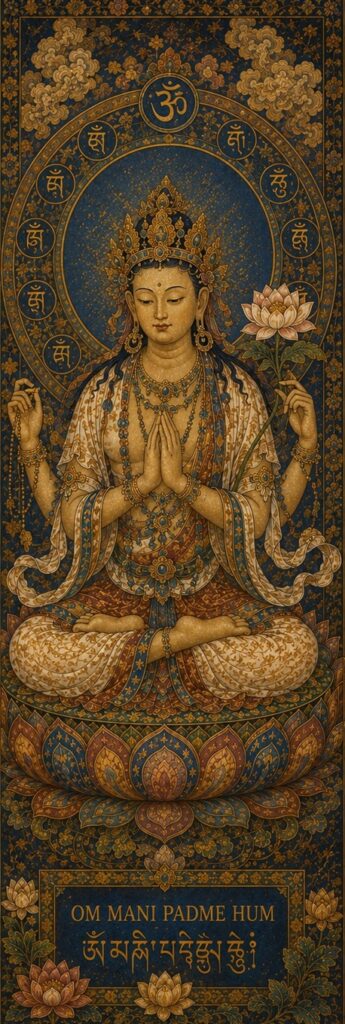
Contemplative chanting is another central practice of our community. We chant traditional sutras, gathas, and mantras not as ritual alone but as forms of meditation that gather the scattered mind, open the heart, and awaken qualities already present within us. Among the mantras we especially treasure is Om Mani Padme Hum, the mantra of the Great Bodhisattva Avalokiteshvara, traditionally recited to cultivate boundless compassion, purify obscurations, and remind us that wisdom and compassion are inseparable. We also chant other Buddha and Bodhisattva mantras as contemplative practices that deepen mindfulness, compassion, and awakened presence.
A distinctive feature of our path is what we call Name-Prayer (Nembutsu) and Name-Mantra. Through the Name-Prayer, Namo Amida Buddha, and the Name-Mantra, Om Namo Amitabhaya, we contemplate Amitabha Buddha, the Buddha of Immeasurable Light and Life, in the spirit of the Pure Land and Shin Buddhist traditions. These contemplative practices cultivate gratitude, humility, trust, and openness to the natural activity of Great Compassion, gently moving us from self-centered striving toward entrusting ourselves to the compassionate wisdom that continually embraces all beings.
At the heart of this unfolding is Bodhichitta, the awakened aspiration to realize Buddhahood for the benefit of all beings. At first, we experience this in a familiar way, as an intention we cultivate through the Bodhisattva Vows, the Six Paramitas, and the Four Immeasurable Minds. This is the arising of compassionate intention within the human heart. Yet as practice deepens, Bodhichitta reveals a second dimension. We begin to recognize that this aspiration is not created by the separate self alone, but is arising from a deeper source.
This is what we call Maha Bodhichitta (Great Bodhichitta). It is the twofold expression of awakening. On one hand, it continues to appear as our sincere wish to help, to care, and to serve. On the other hand, it reveals itself as awakened trust, a deep and quiet knowing that we are already held within boundless wisdom and compassion. In the Shin tradition, this is known as Shinjin, the awakening of the entrusting heart. It is not something we manufacture, but something we awaken to. Maha Bodhichitta is both the movement of compassion toward all sentient beings and the inner awakening of trust in our deepest nature, experienced as the activity of Amida Buddha.
Because awakening is never separate from the lives of others, our practice naturally extends into everyday life. We do not withdraw from the world but seek to embody wisdom and compassion in our families, workplaces, neighborhoods, and communities. Every encounter becomes an opportunity to practice generosity, patience, mindful listening, forgiveness, and compassionate service. All authentic Buddhist practices ultimately point us toward recognizing the same naturally present Buddha Nature. Whether through meditation, mantra, name-prayer, ethical living, or entrusting ourselves to Great Compassion (grace), each expresses and cultivates the same awakening from a different angle. In this spirit, the Dharma is not confined to the meditation hall or chanting service but becomes a living path of awakening in the midst of ordinary life.
Come as you are
For seekers and practitioners.
For individuals and families.
For believers and non-believers.
For those who feel lost and those who are ready to be found.
At the Buddhist Faith Fellowship, labels do not matter. The path of awakening is open to everyone.
Come as you are.

Join Buddhist Faith Fellowship’s Facebook Group. This interactive open space is a great place to learn about Buddhism, share knowledge and experiences with the teachings, and keep in touch with the Fellowship’s activities. Click the Facebook icon to enter.