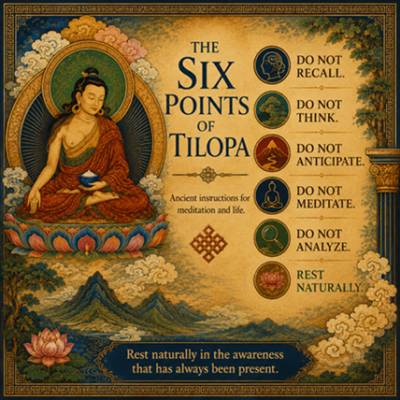
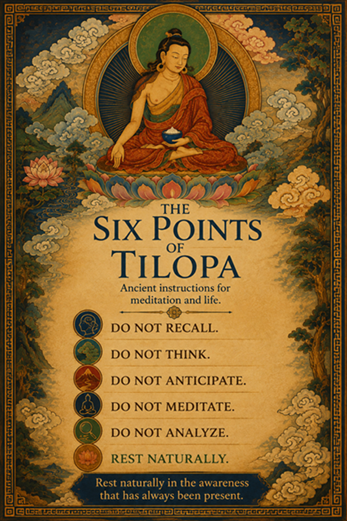
Do not recall.
Do not think.
Do not anticipate.
Do not meditate.
Do not analyze.
Rest naturally.
These six brief instructions were given by the Indian Buddhist teacher Tilopa over a thousand years ago. At first glance they may seem impossible or even confusing. How can we stop recalling, thinking, anticipating, or analyzing? And what could it possibly mean not to meditate?
Yet Tilopa is not asking us to become passive or thoughtless. Rather, he is pointing toward a simpler way of relating to our experience, both in meditation and in daily life. His instructions invite us to stop adding unnecessary struggle and learn to rest in the awareness that is already present.
Do Not Recall. Do Not Anticipate.
Long before Tilopa, the Buddha offered similar guidance in the Bhaddekaratta Sutta:
“Do not chase after the past. Do not seek the future.”
During meditation, memories and plans naturally arise. Tilopa is not telling us to suppress them. He is encouraging us not to follow them. When we notice ourselves replaying the past or rehearsing the future, we gently return to the present moment.
The same principle applies in daily life. Much of our suffering comes from reliving old regrets, resentments, and disappointments, or worrying about futures that have not yet arrived. We can learn from the past and prepare for the future without living in either.
Do Not Think. Do Not Analyze.
Tilopa is not rejecting intelligence or reflection. Rather, he is pointing to our tendency to become trapped in endless mental commentary.
Zen Master Dogen wrote, “To study the Buddha Way is to study the self. To study the self is to forget the self.” Sometimes clarity comes not from more analysis but from letting go of the need to constantly analyze.
In meditation, this means not judging our practice as good or bad, successful or unsuccessful. It also means letting go of theoretical speculation about what is happening. Sometimes our greatest obstacle is not distraction but the constant commentary about our distraction.
In daily life, we often do something similar. We replay conversations, overthink decisions, and analyze situations from every angle. Reflection has its place, but there comes a point where analysis no longer brings clarity. It simply creates more thinking.
Do Not Meditate. Rest Naturally.
Of all Tilopa’s instructions, this one may seem the most surprising. He is not telling us to abandon meditation. Rather, he is pointing beyond meditation as something we try to manufacture.
Contemporary Buddhist teacher Khenchen Thrangu Rinpoche explains that if we try to create emptiness, we create an idea of emptiness. If we try to create luminosity, we create an idea of luminosity. If we strive to produce a particular state, we are still fabricating something.
Instead, Tilopa says, “Rest naturally.”
Allow the mind to rest just as it is, without forcing, fixing, or manipulating. The awareness we seek is not somewhere else. It is already here. It is so close and familiar that we often overlook it.
Ajahn Chah offered a similar image. If muddy water is left undisturbed, it gradually becomes clear on its own. We do not have to force clarity. We simply stop stirring the water.
My Shin Buddhist teacher, Taitetsu Unno, often taught that awakening begins not by fixing ourselves but by accepting ourselves exactly as we are. Shin Master Rennyo likewise reminded practitioners that liberation does not come through self effort alone. At some point, we learn to trust a wisdom greater than our attempts to control everything.
The same is true in daily life. Much of our stress comes from trying to improve, manage, or control every moment. Sometimes wisdom begins when we stop interfering and simply allow ourselves to be present.
Conclusion
The Six Points of Tilopa are not six techniques for becoming something new. They are six invitations to stop adding what is unnecessary.
Let go of the past.
Let go of the future.
Let go of excessive thinking and analysis.
Let go of the need to manufacture a spiritual experience.
Then rest naturally in the awareness that has been present all along.
These instructions can guide us on the meditation cushion, but they can also guide us through the challenges of everyday life. In both cases, Tilopa’s invitation is the same: relax, trust, and rest.
Home Practice
Practice 1: Past, Future, or Present?
Several times each day, pause and ask:
“Where is my mind right now?”
Past? Future? Present?
If you find yourself caught in the past or future, gently return to what is happening right now.
Practice 2: Stop Stirring the Water
Once each day, sit quietly for three minutes.
Let go of fixing.
Let go of analyzing.
Let go of controlling.
Simply rest.
Notice what happens when you stop stirring the water.
Written by Rev. G.R. Lewis, M.A. © G.R. Lewis,
Buddhist Faith Fellowship, July 2026