In a World of Division, the Middle Way
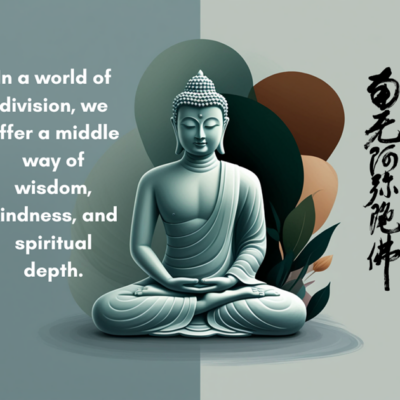
Late in autumn, as the last leaves had fallen and only a few lingered on the branches above the Shoyoan Teien Zen garden, I found myself speaking words that arose extemporaneously. They were shaped by a reading, the season, and the stillness of that moment. During a Dharma talk at the Buddhist Faith Fellowship in Middletown, Connecticut, I said, “In a world of division, we offer the Middle Way of wisdom, kindness, and spiritual depth.”
At the time, I did not set out to make a statement. As is often the case in Dharma talks, the words emerged on their own. Only later did I begin to reflect more deeply on what they pointed toward, and why they felt so necessary now.
We live in a world saturated with division. News cycles amplify conflict. Social media thrives on outrage. Communities, families, and workplaces fracture along lines of identity, belief, and belonging. Yet the most persistent divisions are often the quietest ones, the divisions we carry within ourselves. The harsh inner voices that say, “I am not enough,” “I am a failure,” or “I do not belong” create barriers just as real as those we see on our screens. These inner divisions shape how we meet the world, how we meet others, and ultimately how we meet our own lives.
The Habit of Dividing Reality
We divide reality into I and you, self and world, samsara and nirvana, pure and defiled, ally and enemy. We divide moments into success and failure, worthy and unworthy, sacred and ordinary. Duality becomes our default mode of perception.
Part of this tendency is biological. Our nervous systems evolved to detect threat and difference as a means of survival. Sorting, judging, and categorizing helped our ancestors live. But another reason division persists is habitual. Once the mind learns to split experience into opposing poles, it does so automatically, even when no danger is present. Over time, this habit hardens into identity. We come to believe that these divisions are reality itself, rather than mental constructions.
Buddhist teachings across traditions point to this habit of duality as a fundamental source of suffering. Not because distinctions are useless, but because we mistake them for ultimate truth. We forget that the lines we draw are provisional, functional, and empty of inherent existence.
Wisdom as Seeing Through Division
Wisdom, or prajna, is not the accumulation of information. It is the clear seeing into the nature of experience. Prajna reveals that what we take to be solid, separate, and fixed is in fact interdependent, impermanent, and relational. Through wisdom, we begin to see that the self we defend and the world we resist arise together.
The Srimala Sutra speaks directly to this depth of wisdom, declaring that the Buddha nature is permanent, blissful, self, and pure, not as a personal essence, but as the luminous ground free from defilement. When prajna awakens, division loosens its grip. We no longer need to protect a fragile self against an imagined other.
This wisdom is not abstract. It manifests in how we listen, how we respond, and how we refrain from reacting. It allows us to pause before judgment, to see complexity where we once saw only opposition.
Kindness That Flows From Wisdom
From wisdom naturally arises metta, lovingkindness. Metta (or maitri in Sanskrit), is not sentimental goodwill. It is the embodied recognition that harming another is inseparable from harming oneself. When we see clearly, kindness is no longer a moral obligation. It becomes a natural response.
The Buddha himself demonstrated this again and again. When confronted with hostility, he responded without hatred. When misunderstood, he did not harden. His compassion was not weakness, but clarity in action.
Shinran Shonin, the founder of Shin Buddhism, expressed this same truth through humility. He taught that awakening does not arise from perfecting ourselves, but from entrusting ourselves to the Boundless Compassion. In recognizing our limitations, kindness toward ourselves becomes possible, and from that, kindness toward others flows.
The Heart That Is Settled
In the Jodo Shu’s Seizan tradition, the Anjin Ketsujo Sho speaks of the settling of the heart. Here, heart does not mean the physical organ, nor merely emotion. It refers to the core of our being, where thought, feeling, and awareness converge. In Buddhist terms, heart and mind are not separate. They are one functioning reality.
A settled heart is not one free from difficulty. It is one no longer torn apart by self-division. The Anjin Ketsujo Sho teaches that when entrusting is complete, the heart is settled beyond calculation and doubt. This is not passivity. It is stability rooted in trust.
Inner Transformation, Not Social Engineering
Buddhism does not promise to fix the world by force of ideology. It begins with inner transformation. The question it asks is simple and demanding: how do we meet experience when it arises?
We do not wait to become better versions of ourselves before practicing. We do not wait for self-doubt to disappear before extending kindness inward. Practice begins precisely here, in the midst of uncertainty and fragmentation.
Dzogchen expresses this with remarkable simplicity: awareness does not need to be corrected, only recognized. Zen echoes the same truth in fewer words: nothing is lacking.
The Chinese master Zhiyi described the Middle Way not as a compromise between extremes, but as their transcendence. True balance arises when we no longer cling to either side of a duality. Wisdom sees emptiness. Compassion engages form. Together, they function as one.
The Middle Way We Offer
In a divided world, Buddhism does not offer slogans or easy resolutions. It offers something quieter and more enduring: a way of seeing, a way of being, and a way of relating that does not depend on certainty, perfection, or exclusion.
The Middle Way is not an abstract doctrine. It is lived wisdom, lived kindness, and lived depth. It is the capacity to remain present without collapsing into despair or clinging to righteousness. It is the courage to meet ourselves without violence and others without fear.
As I spoke those words beneath the autumn branches, I did not know where they would lead. Now I see that they point back to the same place the Dharma always points: to this moment, this life, and this possibility of meeting division not with more division, but with understanding, compassion, and trust.
Written by Guiding Dharma Teacher, Rev. G.R. Lewis, M.A.
© 2026 G.R. Lewis
All rights reserved
This article is intended for personal, non-commercial use only. No part of this publication may be reproduced, distributed, or transmitted in any form without the prior written permission of G.R. Lewis, except for brief quotations used for personal study. Contact him directly via our Contact Form.