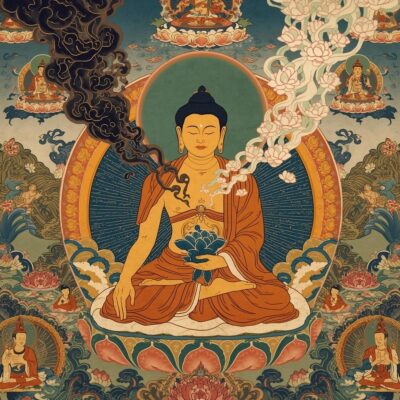
Starting Exactly Where We Are
It is easy to believe that spiritual life begins once we are calmer, less reactive, or more disciplined. We imagine that when our circumstances improve or our emotions settle down, then we will practice sincerely. Until then, we feel as though we are preparing to practice rather than actually practicing. But the path begins exactly where we are.
It begins in the middle of uncertainty, in the awkward conversation that did not go well, in the anxiety that wakes us at night, in the restlessness we notice when we sit down to meditate and discover that our mind is busy and unsettled. We do not need a different mind in order to begin. If irritation is present, we begin there. If fear is present, we begin there. If confusion is present, we begin there.
There is something deeply honest about this. We stop postponing practice until conditions improve. We stop dividing life into spiritual moments and ordinary moments. This moment, exactly as it is, becomes workable. Practice begins the instant we are willing to remain present.
Staying with What Feels Uncomfortable
Most of us are skilled at moving away from discomfort. When something unsettles us, we tighten, defend, withdraw, or protect a certain image of ourselves. Beneath these reactions there is often something tender such as fear of rejection, fear of being wrong, or fear of not being understood.
Instead of escaping the discomfort, we can experiment with staying. We notice the feeling in the body. We feel the heat of anger, the heaviness of sadness, the tightness of fear. We do not dramatize it and we do not suppress it. We allow it to be known.
Fearlessness in Buddhism does not mean the absence of fear. It means we are willing to experience fear without being ruled by it. When we stay present for even a few breaths, we begin to see that the emotion shifts. It is not solid. It is not permanent. It does not define who we are.
Over time this builds quiet confidence. We begin to trust that awareness itself is larger than any passing state. That trust becomes the ground of compassion.
Understanding and Shared Humanity
When we look honestly at our own vulnerability, something softens. We see how easily we become reactive. We see how often we misunderstand others. Instead of condemning ourselves, we begin to recognize that this is part of being human.
As Thich Nhat Hanh wrote, “When you understand, you cannot help but love.” Understanding begins very close to home. When I see my own insecurity clearly, I understand yours. When I acknowledge my own frustration, I soften toward the frustration of others.
Scientists estimate that approximately 120 billion human beings have lived before us. Every one of them experienced longing, fear, hope, and loss. We are not separate from that vast human story. The emotions moving through us today have moved through countless lives before ours.
Recognizing this widens the heart. Practice is no longer about private self improvement. It becomes participation in a shared human life. Compassion grows naturally from that recognition.
Tonglen and the Courage to Connect
Within Tibetan Buddhism there is a practice called Tonglen, which means taking and sending. Tonglen is a method for cultivating compassion and directly experiencing our interconnectedness.
Ordinarily, when we encounter suffering, we contract. We protect ourselves from discomfort. Tonglen gently reverses that movement. Instead of turning away from pain, we turn toward it with openness and courage.
This practice rests on the understanding of emptiness and interdependence. Emptiness does not mean nothing exists. It means nothing exists independently. We are woven together through breath, emotion, history, and relationship. Our lives are part of a vast stream that includes the billions who have come before us and the billions living now. Tonglen unfolds in four stages.
First, we rest in clear natural awareness. We allow the mind to settle into open awareness that is already present. We do not fabricate anything. We simply rest in the spacious and luminous quality of awareness itself. If this feels difficult, we may imagine a Buddha or a warm light glowing gently in the heart, symbolizing awakened presence.
Second, we work with the felt texture of experience. Buddhist teacher Pema Chödrön describes this as working with texture. Suffering often feels heavy, dark, hot, or constricted. Relief feels light, cool, spacious, or bright. We use these qualities in our imagination to support the movement of compassion.
Third, we bring to mind a specific person, a challenging situation, or even our own suffering. As we breathe in, we imagine breathing in the heaviness or darkness of that suffering. As we breathe out, we send light, warmth, and ease. This may be directed toward the person, toward the situation, toward ourselves, or toward all who are experiencing something similar.
Fourth, we broaden the circle. We expand beyond one person to include others who share similar pain. We include those we love, those we find difficult, strangers, and ultimately all beings. In this widening circle, we experience directly that compassion is not limited.
Tonglen can be practiced on the cushion or in the middle of daily life. In a difficult conversation, we can breathe in the shared discomfort and breathe out steadiness. Lying awake at night, we can breathe in the anxiety that many others are feeling and breathe out calm.
Opening to suffering in this way does not weaken us. It strengthens connection. It transforms contraction into care. It allows wisdom and compassion to function together in ordinary life.
Guided Tonglen Practice for Daily Life
Please sit comfortably and allow your body to settle. Let your breath move naturally.
First, rest in clear natural awareness. Notice the simple openness of being aware. If it is difficult to sense this openness, imagine a Buddha or a warm, glowing light in your heart. Let that light represent awakened presence.
Now bring to mind a person in your life who is challenging. Notice what arises in your body as you think of them.
Imagine their pain or suffering emerging from their body or heart in the form of dark, black soot.
As you breathe in, imagine breathing in the dark soot of pain, confusion, or suffering that person is carrying. See it as dark or heavy energy entering your heart.
As you breathe out, imagine sending from your heart to their heart light, warmth, and healing. Imagine that person slowly becoming suffused with that light. Let the out breath carry care, relief, and compassion.
Continue for several breaths.
Then broaden the circle. Include others who are struggling in similar ways. Include people you know and people you do not know. Include those living now and those who have come before us.
Finally, let go of the visualization and rest again in open awareness, connected and present.
© 2026 G.R. Lewis
All rights reserved
This article is intended for personal, non-commercial use only. No part of this publication may be reproduced, distributed, or transmitted in any form without the prior written permission of G.R. Lewis, except for brief quotations used for personal study. Contact him directly via our Contact Form.